Filed under: American Revolutionary War | Tags: Concord, David Preston, Doug Cubbison, Kevin Weddle, Lexington
This lecture fits in really well with our series on the failures at Lexington and Concord. Arrogance defined that day, so it’s no surprise that it was merely a continuation of a pattern. You can view the lecture online tonight (4/12/23) at 6:30pm!
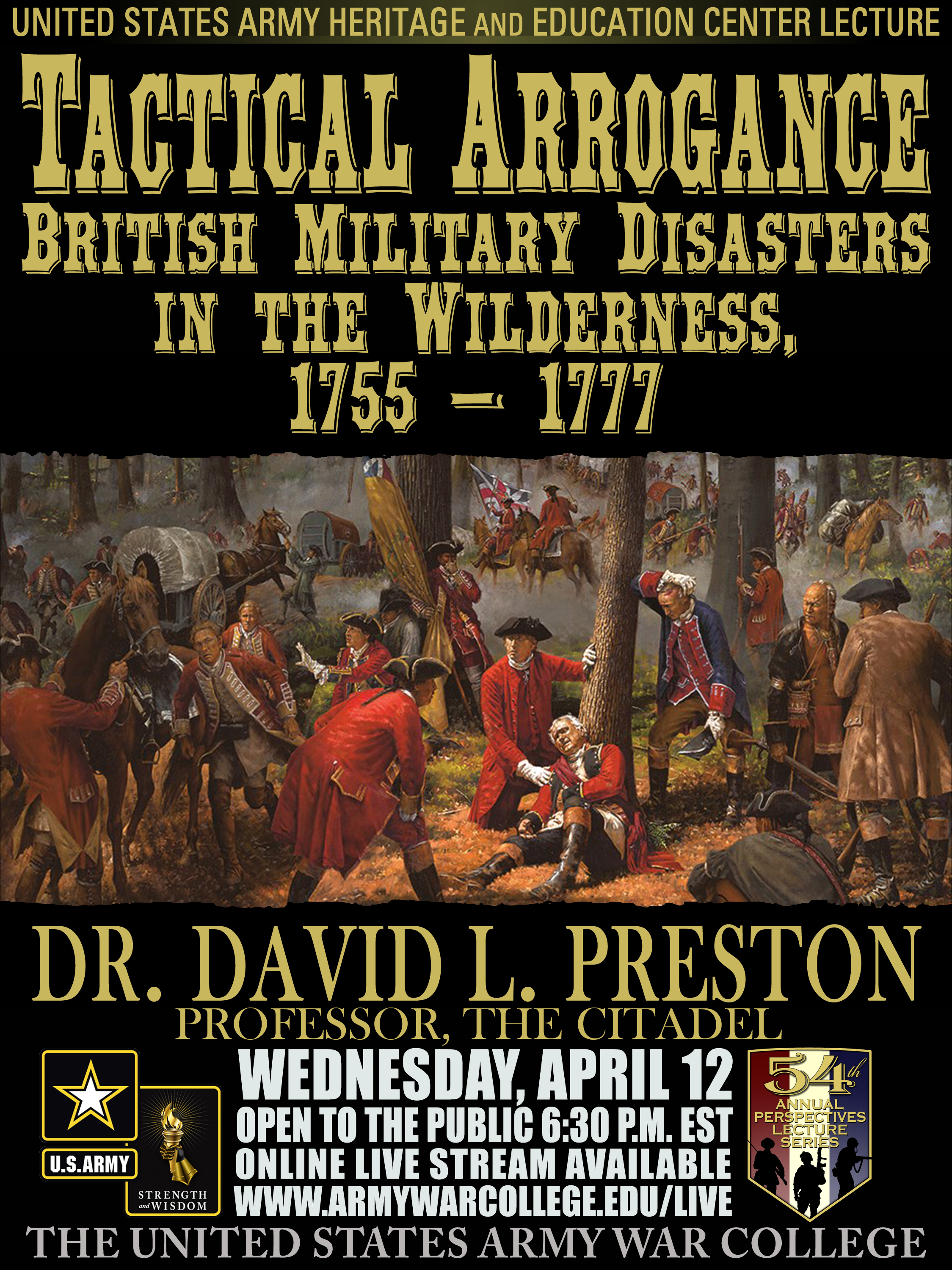
Defeat is a possibility in almost any undertaking. Understanding how to turn failures into lessons learned is a key contributing skill to bringing about future success. In two of his recent books, Dr. David L. Preston, the General Mark W. Clark Distinguished Professor of History at The Citadel, provides a framework of how to draw constructive criticism out of defeat.
Both “Braddock’s Defeat: The Battle of the Monongahela and the Road to Revolution” and “The Other Face of Battle: America’s Forgotten Wars and the Experience of Combat” analyze key takeaways hidden behind the immediate sting of failure, and the dangers of not dedicating time to bring those lessons to light.
Join us on Wednesday, April 12th, at 6:30pm EST as the USAHEC continues our Spring 2023 “Perspectives” Lecture Series with Dr. Preston’s presentation. It will be followed by a roundtable discussion featuring two other distinguished historians and authors, Doug Cubbison (USAHEC Curator and author of “The British Defeat of the French in Pennsylvania, 1758: A Military History of the Forbes Campaign Against Fort Duquesne”) and Dr. Kevin Weddle (U.S. Army War College Professor and author of “The Compleat Victory: Saratoga and the American Revolution”). The event is free and open to the public. Doors open at 6:00 pm EST; and will include book sales and signing.
Live stream viewing available at: https://www.armywarcollege.edu/live/.
Our series on Lexington and Concord can be found here:
- Part I: The Battle of Lexington
- Part II: The British Marine Officers: Pitcairn and Adair
- Part III: The Battle of Concord
- Part IV: General Gage
Filed under: Books, Conferences, Korea, Navy, Understanding Battles, WWII | Tags: Ardant du Picq, Charles Jean Jacques Joseph, Christopher Hamner, Conrad Crane, John Hosler, John Lewis Gaddes, Jonathan Schanzer, Joseph Frechette, Julius Caesar, Keith Bird, Kelly DeVries, Raymond Ibrahim, Roy Appleman, Stephen Bourque, Trent Hone, Ulysses S. Grant, William Donnelly
While my own schedule has changed to preclude much attendance, I’m still a big supporter….
Place: Athena Pallas Greek Restaurant
556 22nd Street, South, Arlington, VA 22202
Menu: Order from the regular menu
Schedule: 5:30 Gathering
6:30 Dinner
7:30 Discussion
Cost: $35
September 17, 2019
Hone, Trent. Learning War: The Evolution of Fighting Doctrine in the U.S. Navy, 1898-1945. 2018.
Speaker: Keith W. Bird, Chancellor-Emeritus, Kentucky Community and Technical College System
October 15, 2019
Appleman, Roy E. South to the Naktong, North to the Yalu. Washington, D.C., 1962.
Speaker: William M. Donnelly, U.S. Army Center of Military History
November 19, 2019
Hosler, John D. The Siege of Acre, 1189–1191: Saladin, Richard the Lionheart, and the Battle That Decided the Third Crusade. 2018.
Speaker: Kelly DeVries, Professor of History, Loyola University Maryland
January 21, 2020
Gaddis, John Lewis. On Grand Strategy. 2018.
Speaker: Tom Keaney, senior fellow, Merrill Center for Strategic Studies, Johns Hopkins Univ, SAIS
February 18, 2020
Grant, Ulysses S. The Personal Memoirs of Ulysses S. Grant. The Complete Annotated Edition. Ed. John F. Marszalek et al. 2017.
Speaker: Christopher Hamner, Associate Professor, Dept. of History and Art History, George Mason University March 17, 2020
March 17, 2020
Ibrahim, Raymond. Sword and Scimitar: Fourteen Centuries of War Between Islam and the West. 2018.
Speaker: Jonathan Schanzer, Senior Vice President, Foundation for Defense of Democracies
April 21, 2020
du Picq, Charles Jean Jacques Joseph Ardant. Battle Studies. Translated and edited by Roger J. Spiller. 2017.
Speaker: Jennie Kiesling, Professor of History and Head Novice Rowing Coach, United States Military Academy
May 19, 2020
Bourque, Stephen Alan. Beyond the Beach: The Allied War Against France. 2018.
Speaker: Conrad Crane, Chief of Historical Services, US Army Heritage and Education Center
June 16, 2020
Julius Caesar, The Landmark Julius Caesar: The Complete Works: Gallic War, Civil War, Alexandrian War, African War, and the Spanish War. Kurt A. Raaflaub and Robert B. Strassler, eds. 2017.
Speaker: Joseph Frechette, Staff historian, U.S. Army Intelligence and Security Command
Filed under: Books, Conferences, Uncategorized, WWI | Tags: Alvin Coox, Bianka Adams, Brian Neumann, Bruce I. Gudmundsson, Conrad Crane, Counterinsurgency, David Crist, Edward Marolda, Geoffrey Parker, Gerhard Gross, Iran, John Kuehn, Julian Corbett, Kelly DeVries, Mark Reardon, Michael Neiberg, Military Classics Seminar, Randy Papadopoulos, Seven Years War, Shane Story, Stuart Goldman, Thirty Years War, Timothy Travers
I’d fallen off on my attendance at the Military Classics Seminar, but if you’re a historian or military history aficionado, you should be attending these. They’ve changed the location of the meetings to the Athena Pallas Greek Restaurant (located at 556 22nd Street, South, Arlington, VA 22202) but the concept remains the same.
Each month, we gather to have a few drinks, enjoy dinner and hear someone give an oral review of a military history book. Some are classics, but some are more modern. Of course, the grandest benefit of attending is meeting your peers. There are military historians from every branch, authors of all kinds, retired military officers and interested amateurs like myself. Some of the greatest benefit to the meetings is the discussion between the attendees throughout the evening. It wanders across all periods of history, including sometimes dealing with personal experiences, and across all kinds of topics.
The dinners cost $35 and there’s a book raffle (I always put in an extra $5 and come away with a book a few times a year). We gather at 5:30pm for a social hour, followed by dinner at 6:30pm and the presentation at 7:30pm. There is some parking in the restaurant’s lot and some along neighboring streets.
Make your reservation no later than the Wednesday prior to the meeting by replying Eric Joyce at this e-mail address militaryclassics@gmail.com or to Bob Goldich by phone at (703) 359-1074. Pay for the meal with check or cash ($35) at the entrance to the meeting room. Those who make a reservation and do not show are still obligated for the cost of the dinner.
September 25, 2018 (one week delay because of Yom Kippur)
Parker, Geoffrey. The Thirty Years War. 1984.
Speaker: Kelly DeVries, Loyola University
October 16, 2018
Kuehn, John T. America’s First General Staff: A Short History of the Rise and Fall of the General Board of the Navy, 1900-1950. 2017.
Speaker: Edward J. Marolda, U.S. Naval Institute
November 20, 2018
Coox, Alvin D. Nomonhan: Japan Against Russia, 1939. 1985.
Speaker: Stuart Goldman, Scholar in Residence, National Council on Eurasian and East European Research
January 15, 2019
Corbett, Julian S. England in the Seven Years War: A Study in Combined Strategy. 1907.
Speaker: Randy Papadopoulos, Secretariat Historian, Department of the Navy
February 19, 2019
Travers, Timothy. The Killing Ground: The British Army, the Western Front, and the Emergence of Modern Warfare, 1900-1918. 1987.
Speaker: Bruce I. Gudmundsson, DPhil, Quantico, Virginia
March 19, 2019
Crane, Conrad C. Cassandra in Oz: Counterinsurgency and Future War. 2016.
Speaker: Shane Story, Director, General Histories Division, U.S. Army Center of Military History
April 16, 2019
Crist, David. The Twilight War: The Secret History of America’s Thirty Year Conflict with Iran. 2012.
Speaker: Mark Reardon, Senior Historian, Histories Directorate, U.S. Army Center of Military History
May 21, 2019
Gross, Gerhard P. The Myth and Reality of German Warfare: Operational Thinking from Moltke the Elder to Heusinger. 2016.
Speaker: Bianka Adams, Historian, U.S. Army Corps of Engineers
June 18, 2019
Neiberg, Michael. Dance of the Furies: Europe and the Outbreak of World War I. 2013.
Speaker: Brian F. Neumann, Historian, Contemporary History Division, U.S. Army Center of Military History
A nice piece on the sinking of the Lusitania as we commemorate the 100th anniversary of World War I….
With the start of the First World War, many were expecting a titanic clash of the German and British navies, the race between the two for sea supremacy being one of the myriad of factors that the war had begun over in the first place. The commencement of hostilities had led to widespread fears that […]
via Ireland’s Wars: The Lusitania — Never Felt Better
Filed under: Marines, WWI | Tags: 2nd Infantry Division, 4th Marine Brigade, 6th Marines, Alan Axelrod, Ancestry.com, Belleau Wood, Bunker Hill, Chapultepec, Craig Hamilton, Lexington, Louise Corbin, Lundy's Lane, Robert Asprey, Thomas Holcomb, Valley Forge
100 years ago, Thaddeus Stephenson Allen answered his country’s call and enlisted in the Marine Corps. T.S. Allen soaked up history as a young man, reading
stories of Lexington and Bunker Hill, Valley Forge, Lundy’s Lane, Chapultepec. These seemed to me like those stories which begin, “There were giants in those days.” Still, they gave a heroic background in my mind for the closer events of the Civil War, and the brief but glorious episodes of the War with Spain, in reading of which I was first introduced to the Marines.
The internet is an amazing thing. I was reading Alan Axelrod’s “Miracle at Belleau Wood: The Birth of the Modern U.S. Marine Corps” and he quoted, but did not identify one of the Marines in MAJ Thomas Holcomb’s 6th Marines. Checking the end notes, I found that it was from “Echoes from Over There” (Edited by Craig Hamilton and Louise Corbin), as quoted in Robert Asprey’s “At Belleau Wood“. Fortunately, “Echoes from Over There” is available online, so I was able to not only to find the original quote, but the full, first-hand story of Marine Private T.S. Allen. Not only that, but with a quick visit to Ancestry-dot-com, I was able to find out considerably more details about his family. (Sadly, once I get on that site, it’s a time-sink for me and I emerge hours later knowing many things, most of which are of no relevance to what I was looking for originally!)
He writes vividly of his first experience in combat, drawing on his knowledge of history. He wrote this while still hospitalized due to being gassed in Belleau Wood and one can easily see how he’d eventually end up in the newspaper business…
“Here they come!” a shrill boyish voice piped up.
“Hold your fire!” the injunction ran from officer to officer and man to man.
The German barrage lifted; the French guns almost ceased firing. The men about me were cursing and swearing in that choice collection of profanity that belongs to the Marines. It took me back swiftly, on the wings of memory, to a lonely walk in the woods I had taken, as a boy, when I had whistled to keep up my courage.
The German troops were clear of the woods. On they came with closed ranks in four lines. One looked at them with almost a friendly interest. No particular hate or fear. And yet there was a queer sensation along the spine, and the scalp seemed to itch from the tug of the hair at the roots. The fingers bit into the rifle.
“Hold your fire!”
As the command rang on my ears with a sharpness that enforced obedience, I seemed to be standing on Bunker Hill and hear the command: “Wait till you see the whites of their eyes!”
I think I know how those old Yanks felt that day, as the enemy drew nearer and nearer.
The next I recall is firing. Firing. Firing. My fingers were tearing greedily at more ammunition, then the instinct of the hunter restrained me. I began to fire slower, looking for my mark, making sure of a hit. The Huns now appeared to me almost on top of us and then, all of a sudden, there was nothing more to aim at. A few scattered groups with hands held up, racing for our lines and shouting “Kamerad! Kamerad!”
The Marines weren’t the only ones there, as Army units were on both sides of them, but this fight really does deserve credit for “The Birth of the Modern U.S. Marine Corps”. It remains legendary in the Corps and I hope to be able to some more research to learn the stories of these Marines and share them with you. If my cards fall right, I’ll be in Belleau Wood next year, walking the ground. After all, that’s the only way to understand it.
Filed under: Books, Conferences, WWI, WWII | Tags: Battle of the Somme, Bob Scales, Bud Cole, China, David Silbey, George Patton, Jeff Gibbs, John Lillard, Kelly Morningstar, Kevin Hymel, Malta, Margaret Stoltz, Military Classics Seminar, Military History Legion, Pecan Pie, University Club, Wargaming, William Philpott
The next Military Classics Seminar (18 April 2017) will feature a review of William Philpott’s Three Armies on the Somme: The First Battle of the Twentieth Century, by David Silbey, Professor and Associate Director at Cornell University in Washington. You have 8 days to read it!
If you’ve not attended the seminars before, you’re truly missing out. Each month (minus some summer months and December), either a member or a guest speaker provides and oral review of a military classic or a recent book of note. Discussions both precede and follow the commentary by the speaker. There’s dinner and a bar, so no one goes hungry or thirsty. The opportunity to discuss military history and rub elbows with a variety of historians is worth considerably more than the nominal $35 cost for the dinner. It’s held at the Fort Myer Officer’s Club and we gather at 5:30pm, with dinner served at 6:30pm and the talk starting around 7:30pm. The dinners are always good, but this month is special, as the dessert is pecan pie!
Contact Co-Secretary Eric Joyce via email: militaryclassics -at- gmail.com to make your reservation.
I also wanted to pass along the upcoming speakers and events at the University Club’s Military History Legion. I’ve not yet attended, but will likely circle July 11th, since Kevin Hymel doesn’t talk enough about Patton for me to have my fill….
Dinner is afterward, but there is an $18.00 open bar – Wine, beer, soft drinks and complimentary popcorn to hold you over during the talk.
All events are at the University Club: 1135 16th Street, NW, Washington, DC 20036, Phone: 202 862-8800. You may also join us for dinner with the speaker afterward. Non-members may use credit cards or cash for dinner. Business attire (no jeans). Valet parking available: $12 for 2 hrs, $17 for 2+ hrs; some metered parking nearby but may run until 10 pm!
Questions? Contact Margaret Stoltz: mstoltz -at- universityclubdc.com. or Jeff Gibbs: tigrejj -at- aol.com
May 16, 2017 (Tues) – “China’s Quest for Great Power” by CAPT. Bud Cole USN (ret) will explain China’s naval expansion, and its linkage to the pursuit of secure energy sources and Chinese foreign policy, both globally and in an Asian context; in a presentation that we hope will be in time to anticipate pending developments in the South China Sea.
June 8, 2017 (Thurs) – “Playing War: Wargaming WW II in the Pacific” by John Lillard, will discuss the history and nature of wargaming and how the wargames conducted by the Naval War College allowed the US Navy to foresee the course of the battle for the Pacific during WW II.
June 20, 2017 (Tues) – “Scales on War: The Future of America’s Military at Risk” by MGen. Bob Scales USA(r), who will illustrate how, through the experience of recent conflicts in Iraq, Afghanistan and elsewhere, our adaptive enemies learned how to defeat American technology, and why a resurgence of neglected Army and Marine small units is now required.
July 11, 2017 (Tues) – “Patton’s Way: A Radical Theory of War” by Kelly Morningstar, who will describe Gen. George Patton’s radical doctrine of war, developed over decades, that contradicted official Army doctrine but led to brilliant successes such as his breakout from the Normandy pocket that shattered German resistance and liberated Paris.
August 24, 2017 (Thurs) – “The Great Siege – Malta 1565” by Jeff Gibbs, about one of the most celebrated but now neglected events of the period: the dramatic, desperate siege of Malta, where the Knights and the Maltese people heroically crushed the myth of Turkish invincibility.
Filed under: Conferences, Veterans | Tags: 62nd Naval Construction Battalion, Iwo Jima, Navy, Sea Bees, Thompson SMG
During the reunion for the 71st anniversary of the Battle of Iwo Jima, I had the chance to meet Norman L. Baker.
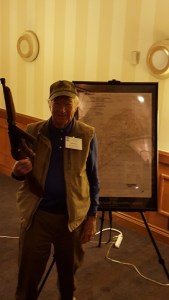
Norman Baker of the security element for HQ Company, 62nd Naval Construction Battalion, attached to Fifth Amphibious Corps
Norm served in the Sea Bees (Naval Construction Battalions) during World War II, but Norm wasn’t a skilled laborer like most of the men in the Sea Bees. He was just a young guy and assigned as part of the security detachment for Headquarters Company, 62nd Naval Construction Battalion. The battalion was attached to the Fifth Amphibious Corps, so he landed on Iwo Jima to provide security for the engineers and tradesmen.
Unlike Marines in the line, this ended up allowing him some opportunities for ‘wandering’. He told me of his fascination with airplanes, especially fighter planes. As soon as the airfields were “secured” enough that they could risk basing planes there, they did. So, Norm had a chance to get up close and personal with the planes. He related that one time, a fighter plane taxied off the runway and the pilot hopped down when he was nearby. The pilot was a young red-headed fellow, probably right about Norm’s age and was thrilled to be able to show him everything there was to know about the plane. It’s a thrill he still remembers. When he went back a few days later to see if he could find his new friend, Norm was told he wasn’t there anymore. One hopes that the pilot was merely injured or reassigned, but I can’t help but imagine that he was among the thousands who paid with their lives for the Marines to secure Iwo Jima.
Due to the proximity of the National Museum of the Marine Corps and the high profile of the event, several docents from the museum were in attendance and brought along some artifacts. When Norm was on Iwo Jima, he carried a Thompson Submachine Gun, as he is here in the photo. It was just happenstance that I saw him drift over and ask the docents if he could hold the gun. So, we all got some nice shots of Norm posing in front of the map they’d brought from the museum.
Attending these reunions is always among the highlights of my year because there’s such an opportunity to meet and mingle with some wonderful veterans, their families, historians and Marines of every era. Importantly, never forget the Sea Bees!
Filed under: Colmar Pocket, Conferences, Operation Dragoon | Tags: George Mason University, Spirit of America
There’s been a big change for the Dragoon/Colmar event this week. On Friday morning, we’ll be attending the Spirit of America show at George Mason University instead of conducting the third historical seminar session. That third session will now occur from 2-6pm that day.
| 18 Sept: | 9 AM to 1:30 PM | Spirit of American show at George Mason University |
| 2 PM to 6PM | Historical seminar III |
Full schedule available on the 6th Army Group website
Filed under: Conferences | Tags: Alan Turing, Alistair Horne, Andrew Hodges, Arthur Conger, Carl von Clausewitz, Christopher Bassford, Daniel Moran, Enigma, Erik Villard, Gregory A. Daddis, Gregory W. Pedlow, Jon Sumida, Katherine C. Epstein, Lawrence Freedman, Mark Mandeles, Michael Bigelow, Military-Industrial Complex, Pacific War, Paul Jankowski, Perry Jamieson, Richard Overy, Robert Goldich, Ron Spector, Saburō Ienaga, Stan Falk, Strategic Bombing, U.S. Grant, Verdun, Vietnam, Walton Moody, Waterloo, William Westmoreland, World War II
As I’ve noted before, I stumbled upon the Military Classics Seminar about a year ago and it’s the group I’ve been looking for the last twenty years. Each month, we gather in the Officers’ Club at Fort Myer to have a few drinks, enjoy dinner and hear someone give an oral review of a military history book. Some are classics, but some are more modern. Of course, the grandest benefit of attending is meeting your peers. There are military historians from every branch, authors of all kinds, retired military officers and interested amateurs like myself. Some of the greatest benefit to the meetings is the discussion between the attendees throughout the evening. It wanders across all periods of history, including sometimes dealing with personal experiences, and across all kinds of topics.
The dinners cost $35 and there’s a book raffle (I always put in an extra $5 and come away with a book a few times a year). We gather at 5:30pm for a social hour, followed by dinner at 6:30pm and the presentation at 7:30pm. To get onto Fort Myer, you need to use the Hatfield Gate unless you have a military ID. They will do an ID check and a routine inspection of your vehicle.
Make your reservation no later than the Wednesday prior to the meeting by replying Eric Joyce at this e-mail address militaryclassics@gmail.com or to Bob Goldich by phone at (703) 359-1074. Pay for the meal with check or cash ($35) at the entrance to the meeting room at Ft. Myer. Those who make a reservation and do not show are still obligated for the cost of the dinner.

2015-2016 Schedule
September 15, 2015
Overy, Richard. The Bombing War: Europe, 1939-1945. 2013.
Speaker: Walton Moody, Retired Historian
October 20, 2015
Saburō Ienaga, The Pacific War, 1931-1945: A Critical Perspective on Japan’s Role in World War II. 1978.
Speaker: Stan Falk, Independent Historian
November 17, 2015
Conger, Arthur. The Rise of U.S. Grant. 1931.
Speaker: Perry Jamieson, Independent Historian
January 19, 2016
Carl von Clausewitz, On Waterloo: Clausewitz, Wellington, and the Campaign of 1815. Transl. & ed. by Christopher Bassford, Daniel Moran, and Gregory W. Pedlow. 2010.
Speaker: Jon Sumida, Professor of History, University of Maryland, College Park
February 16, 2016
Daddis, Gregory A. Westmoreland’s War: Reassessing American Strategy in Vietnam. 2014.
Speaker: Erik Villard, Historian, U.S. Army Center of Military History
March 15, 2016
Hodges, Andrew. Alan Turing: The Enigma. 2014.
Speaker: Michael Bigelow, Command Historian, U.S. Army INSCOM
April 19, 2016
Dual selection: Alistair Horne, The Price of Glory: Verdun 1916. 1961, rev. ed. 1994, and Paul Jankowski, Verdun. 2014.
Speaker: Robert Goldich, Independent Historian
May 17, 2016
Katherine C. Epstein, Torpedo: Inventing the Military-Industrial Complex in the United States and Great Britain. 2014.
Speaker: Mark Mandeles, President, The J. de Bloch Group
June 21, 2016
Lawrence Freedman, Strategy: A History. 2013.
Speaker: Ron Spector, Prof. of History and International Relations; George Washington University
 We're not lost, Sergeant, We're in ... France